Why You Should Install Prana Heat Recovery Units (Decentralised Heat Recovery Ventilation Systems)
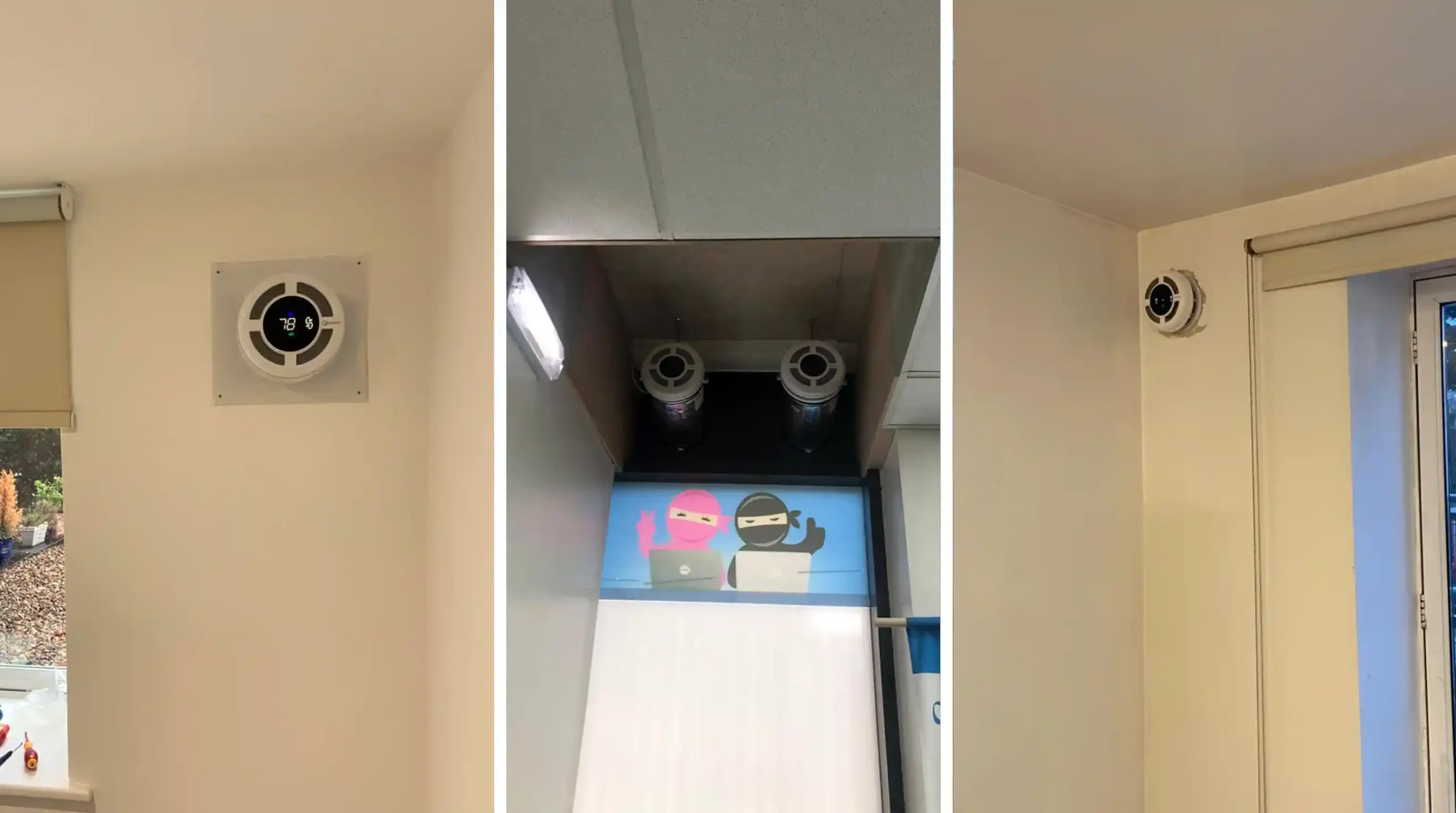
6 reasons a Prana heat recovery unit might be the smartest thing you put in your walls
There is a particular type of home improvement that never makes it onto renovation mood boards. No one pins it to their Pinterest. It does not photograph well for Instagram. It is not glamorous in the way that a new kitchen or a tiled bathroom is glamorous.
And yet, for the people who have it, it quietly transforms the experience of living in their home more than almost anything else they have ever done to it.
We are talking about wall ventilation — specifically, the kind that brings in fresh air, pushes out stale air, and recovers the heat in between. It happens behind a small white disc on your wall. It runs so quietly you forget it is there. And it solves problems that no amount of repainting, bleaching, or dehumidifying ever quite managed to fix.
Here is why it is worth taking seriously.
1. No more damp. No more mould. Permanently
Let us begin with the problem that brings most people to this conversation in the first place.
Black mould is not an aesthetic problem, though it is certainly that too. It is a health hazard — one that produces airborne spores linked to respiratory conditions, allergic reactions, and chronic fatigue. It disproportionately affects children and the elderly. And it is, in most British homes, entirely preventable.
The reason mould grows on walls, in corners, and around window frames is condensation — moisture in the room air settling on cold surfaces. The reason condensation forms is that the air is too humid and has nowhere to go. The reason the air is too humid is that the room is not being properly ventilated.
A Prana decentralised heat recovery ventilation unit addresses this at the source. By continuously exchanging the moisture-laden air in the room with drier fresh air from outside, it keeps indoor humidity at a level where condensation simply cannot form. Window condensation disappears. The dark patches in the corners stop coming back. The mould, deprived of the conditions it needs to survive, does not return.
This is not a management strategy. It is a permanent fix — one that works because it addresses the cause rather than the symptom.
2. Fresh air around the clock — without losing your heat
The objection that almost everyone raises at this point is a reasonable one: if you are constantly pumping air in from outside in January, surely you are just paying to heat the street?
This is where heat recovery ventilation earns its name.
At the core of every Prana unit sits a heat exchanger. As warm stale air leaves the room, it passes through this exchanger and surrenders most of its thermal energy. That energy is then transferred to the cold incoming air before it enters the room. The result is that the fresh air arriving in your bedroom or living room is not the biting outside temperature — it has already been warmed by the air it is replacing.
Prana units recover up to 96% of the room’s heat in this process. In practical terms, this means you can have genuine, continuous fresh air ventilation running through the coldest months of a British winter with a negligible impact on your heating bill. The air quality of an open window. The warmth of a sealed room. At the same time.
3. A copper heat exchanger — built-in antiseptic
Most people, when they learn about heat recovery ventilation, ask a reasonable follow-up question: is the air that comes through the unit actually clean?
In Prana units , the answer is yes — for a reason that is both clever and centuries old.
The heat exchanger in a Prana unit is made from copper. Copper has well-documented natural antimicrobial properties — it has been used in medical settings and water systems for this reason for generations. Bacteria and viruses that contact copper surfaces are destroyed, typically within minutes. In the context of a ventilation unit, this means that the air passing through the heat exchanger is not just being warmed — it is being cleaned.
What enters the room is fresh air that has passed through a naturally antiseptic medium. For households with young children, elderly residents, or anyone with compromised immunity — and particularly for medical facilities, nurseries, and care settings — this is not a minor footnote. It is a meaningful difference from other ventilation technologies that offer no such protection.
4. Reduced energy bills — not just in theory
Ultra-low energy consumption is a phrase that appears in a great deal of marketing material and means very little without context. In the case of Prana heat recovery units, the figures are worth examining.
A typical Prana unit running continuously consumes between 3 and 8 watts of electricity depending on the speed setting — comparable to a low-energy LED bulb. Running continuously for a full year at average UK electricity rates, the energy cost is marginal. Meanwhile, the heat recovery process means that far less of the energy you are already spending on heating is lost to ventilation.
For homes that have previously relied on opening windows for air quality — even intermittently — the reduction in heating loss can more than offset the unit’s running costs. For homes that have been running dehumidifiers to manage damp, the electricity saving compared to those devices (which typically consume 300–700 watts) can be substantial.
The energy argument for heat recovery ventilation is not hypothetical. It is straightforward arithmetic — and it tends to improve rather than worsen as energy prices remain elevated.
5. Installed MVHR in hours, no redecorating required
Mention “ventilation system” to most homeowners and they immediately picture building works. Ceilings opened up. Ducts threaded through joists. Weeks of disruption. Replastering and repainting.
That is the reality of a centralised, ducted MVHR system — excellent technology, but designed for new builds or major renovations.
A Prana decentralised unit is an entirely different proposition. Installation requires a single core drilled through the exterior wall — a clean, precise hole, typically 160mm in diameter. The core sleeve is fitted, the unit is mounted on the internal wall plate, and the external grille is fitted outside. In most properties, the entire process takes two to four hours per unit. There is no ductwork, no ceiling disruption, no structural modification, and no damage to the room’s decoration beyond the wall penetration itself — which is covered cleanly by the unit’s fascia.
For homeowners who have been putting off ventilation improvements because of the anticipated disruption, this is worth pausing on. The barrier to installation is lower than almost any other meaningful home improvement. And the improvement itself, once made, is permanent.
6. Smart climate control from your smartphone (decentralised MVHR)
The last piece of the picture is the one that tends to most surprise people who associate ventilation with crude on/off switches and noisy extractor fans.
Prana units come equipped with built-in CO₂ and humidity sensors that continuously monitor the air quality in the room. When CO₂ rises — because the room is occupied, or because a window has been shut for an extended period — the unit automatically increases its ventilation rate. When humidity spikes — during or after a shower, or on a particularly damp evening — the unit responds accordingly, then steps back down once conditions normalise.
All of this can be monitored and adjusted via a smartphone app. You can set schedules, check live air quality readings, adjust fan speeds, and configure automatic responses — all from your phone, from wherever you happen to be. For a family home, this means the children’s bedroom can be managed from the kitchen. For a landlord with multiple properties, it means remote oversight without site visits.
The result is a genuinely smart home ventilation system — one that is responsive rather than passive, intelligent rather than simply mechanical, and always working quietly in the background to maintain the air quality in your home at a level that manual management could never reliably achieve.
Putting it together: what a Prana MVHR unit actually changes
Fresh air without heat loss. No mould, no condensation, no damp patches returning. Bacteria-free air through a copper heat exchanger. Reduced energy bills. Installation in a single morning. And full smart control from a smartphone.
None of these things individually is a small claim. Together, they describe a home environment that is measurably healthier, more comfortable, and more energy-efficient — delivered through a unit the size of a dinner plate that most visitors will barely notice on the wall.
The people who fit one and find themselves wondering why they did not do it sooner are not reacting to the technology. They are reacting to the gap between what they expected ventilation to be, and what it actually turns out to be when it is done properly.
Find the right Prana decentralised MVHR unit for your home or building
At Brilydan, based in Oldbury in the West Midlands, we supply and install Prana heat recovery ventilation units for homes, offices, schools, medical facilities, restaurants, and commercial premises across the whole of the UK. We are happy to help you identify the right unit for your specific room, building type, and budget — without the jargon, without the pressure.
Or browse the full range of Prana decentralised MVHR units and see what suits your property.
Brilydan is based in Oldbury, West Midlands, and serves residential and commercial customers.
Contact our expert team for a free consultation to find the perfect solution for your home.

Want to know more?
Request a free consultation with our ventilation experts to discuss your specific needs.
Our Featured Glasses
-
Sale!

Climtec 200mm Activated Carbon Filter (Optional Upgrade)
£25Original price was: £25.£19Current price is: £19. -
Sale!
Climtec 200mm Decorative Outer Ring
£30Original price was: £30.£24Current price is: £24. -
Sale!
Climtec 100mm Decorative Outer Ring
£12Original price was: £12.£9Current price is: £9. -
Sale!
Climtec 100mm Activated Carbon Filter (Optional Upgrade)
£25Original price was: £25.£19Current price is: £19.

