Your child is exhausted after exercise, but the problem may lie in the air in the rooms
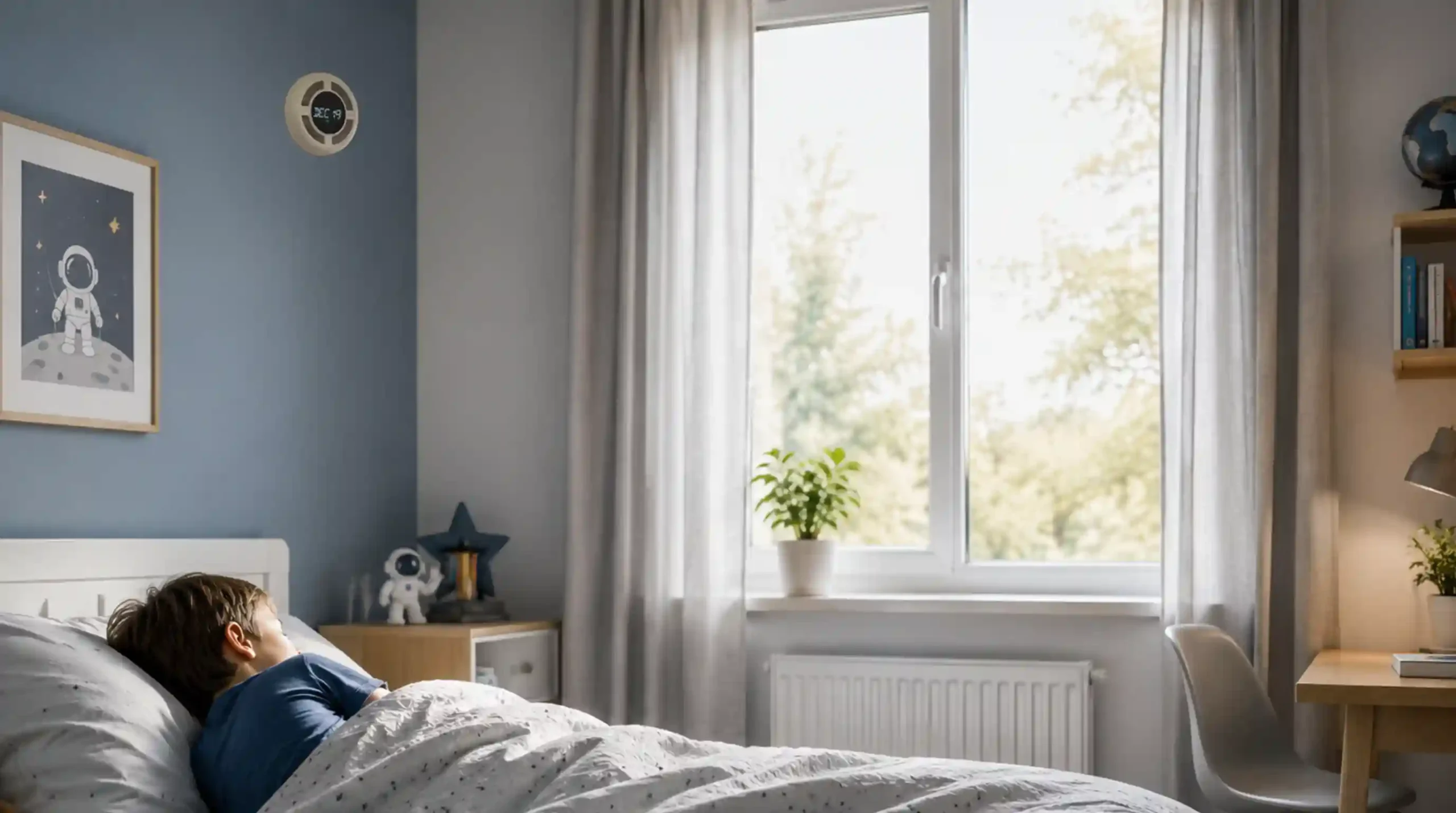
You watch your child push through every session. They train hard, eat well, sleep the right number of hours — and yet they are still waking up tired. They drag themselves to school. They lose concentration by mid-afternoon. By the time training comes around again, they are running on empty.
Most parents go looking in the obvious places: too much screen time, not enough protein, training load too high. These are reasonable things to examine. But there is one factor that almost nobody checks — and it is happening every single night, in the room where your child is supposed to be recovering.
The air in their bedroom may be quietly working against them.
The invisible problem in every sealed room is ventilation in the rooms
Here’s something to know about how we sleep. A child in a small bedroom exhales carbon dioxide throughout the night. In a poorly ventilated room – which is the case in the vast majority of British bedrooms, especially in the winter months when the windows are tightly closed – CO₂ levels can rise to two, three, even four times higher than in the fresh air outside.
At these levels, the body doesn’t rest as effectively. The quality of sleep is reduced. A brain deprived of optimal oxygen doesn’t consolidate memory or repair tissue as effectively as it should. A child wakes up having technically slept for eight or nine hours, but the quality of that sleep is subtly undermined by the air they’ve been breathing throughout their sleep.
This is not a fringe theory. It’s well documented in building science and is increasingly recognised in sports medicine and paediatric health research. Poor indoor air quality, lack of ventilation, especially elevated CO₂ levels and high humidity, is directly linked to fatigue, cognitive decline, and slower physical recovery. For a young athlete trying to improve their performance, this can imperceptibly limit their progress, no matter how good their training program is. And it’s not just the bedroom. If your child studies in a room with poor ventilation, the same effect is seen when doing homework. Concentration decreases. Motivation disappears. They’re not lazy—they’re functioning in an environment that physiologically works against them.
Why standard ventilation fixes don't work
The instinctive response is to open the window. And in many cases, that helps — in summer, or on mild days, or in quiet suburban streets. But in a British winter, leaving a bedroom window open overnight is neither practical nor comfortable, and in urban areas, external noise and air pollution can make it genuinely counterproductive.
Extractor fans in bathrooms help with moisture but do nothing for bedroom air quality. Dehumidifiers remove humidity but do not introduce fresh air. Air purifiers recirculate and filter existing air but do not address the fundamental problem: the CO₂ and moisture your child is adding to the room throughout the night needs to leave, and fresh air needs to come in to replace it.
What is needed is a continuous, controlled exchange of air — one that does not rely on weather, memory, or open windows. This is precisely what a modern home ventilation system is designed to provide.
Heat recovery: fresh air without the heat loss
A heat recovery ventilation unit — known as an HRV unit or, in its whole-house form, an MVHR system — solves this problem elegantly. It draws stale, CO₂-rich, humid air out of the room and simultaneously brings fresh air in from outside. The heat exchanger at its core captures warmth from the outgoing air and transfers it to the incoming air, meaning the room stays comfortable even in winter.
The result is a bedroom that breathes continuously — not through draughts, not through a window left ajar, but through a controlled, quiet, purpose-built process that runs through the night without disturbing anyone’s sleep.
For a child who trains regularly, this matters more than it might for the average occupant. Recovery during sleep is when the body repairs muscle, consolidates motor skills, and restores energy reserves. Anything that compromises sleep quality compromises recovery. A proper bedroom ventilation system removes one of the most overlooked obstacles to that process.
Quality ventilation solutions for every room in your home
The good news is that this does not require a whole-house overhaul. Single room heat recovery units — compact ventilators fitted directly through an exterior wall — make it possible to address individual rooms without ductwork, without structural disruption, and without the costs associated with whole-building MVHR installations.
The Prana recuperators, for instance, works on a clever alternating cycle: it draws fresh air in through a ceramic heat exchanger core, then reverses to expel stale air, capturing up to 96% of the room’s heat in the process. It operates virtually silently — well within the noise range that would disturb a sleeping child — and can be controlled remotely or set to run automatically based on air quality sensors.
The Climtec units twin-core units offer a continuous (rather than alternating) airflow by using two cores simultaneously — one for supply, one for extract — making them particularly well-suited to larger bedrooms or rooms where a child both sleeps and studies. Fresh air in, stale air out, at all times, without interruption.
Both units of MVHR are wall-mounted, discreet, and designed for exactly the kind of domestic ventilation scenario that affects British families every day: a sealed, well-insulated room that needs proper fresh air ventilation without sacrificing warmth or generating noise.
This approach also scales naturally. If bedroom ventilation is the starting priority, a single unit resolves it. If the concern extends to a home study room, a playroom, or a basement gym space, additional units can be added independently — each one a self-contained improvement to that room’s air quality and, by extension, the recovery and performance of the person using it.
Note to parents of young athletes. MVHR - improves air for better and more productive training
If your child trains more than three times a week — in any sport — their recovery environment deserves the same attention as their training programme. Coaches focus on load, nutrition, and technique. Almost no one talks about the air quality of the rooms where young athletes sleep and study.
It is a small change with a disproportionate effect. Parents who have made the switch consistently report that their children sleep more soundly, wake with more energy, and seem sharper during the school day. Whether that is attributable entirely to the ventilation improvement is impossible to say with certainty — but the science behind it is solid, and the anecdotal evidence is consistent.
At Brilydan, based in Oldbury in the West Midlands, we help families across the whole of the UK find the right home ventilation solution for their situation. Whether it is a single bedroom that needs fresher air or a full domestic ventilation system for a new property, we are happy to talk through the options — straightforwardly, without pressure.
If you’re fed up with constantly battling mould, wiping condensation off your windows every morning, and wasting money on heat lost through standard extractor fans, it’s time for a real change.
Ready to breathe truly fresh air in your own home? Explore our range of Prana and Climtec heat recovery systems today at https://brilydan.co.uk/. Alternatively, get in touch with the Brilydan team for a free, no-obligation chat to find the perfect unit for your space.

Want to know more?
Request a free consultation with our ventilation experts to discuss your specific needs.
Our Featured Glasses
-
Sale!

Climtec 200mm Activated Carbon Filter (Optional Upgrade)
£25Original price was: £25.£19Current price is: £19. -
Sale!
Climtec 200mm Decorative Outer Ring
£30Original price was: £30.£24Current price is: £24. -
Sale!
Climtec 100mm Decorative Outer Ring
£12Original price was: £12.£9Current price is: £9. -
Sale!
Climtec 100mm Activated Carbon Filter (Optional Upgrade)
£25Original price was: £25.£19Current price is: £19.

